TABLE OF CONTENTS
Preamble
During timetable construction, teacher or room clashes, spread problems, or part-time issues may arise. While the 'Improve' function can often resolve these, some problems may persist. If issues remain after extended attempts, it is important to investigate the underlying causes preventing resolution. This document provides some ideas to help troubleshoot persistent problems.
NOTE
Click on the Master grid score to view the list of issues including clashes and spread problems.
Solving teacher clashes
1. Review part-time teacher's days off
- Often, part-time teachers are the biggest cause of clashes.
- Review and edit class spreads if needed, to cater for part time staff availability.
- Analyse different day off combinations, make changes based on these insights, then run Improve.
2. Use flags
- To locate teachers/classes to help see the issue
- To highlight potential staff swaps
3. Try staff swaps
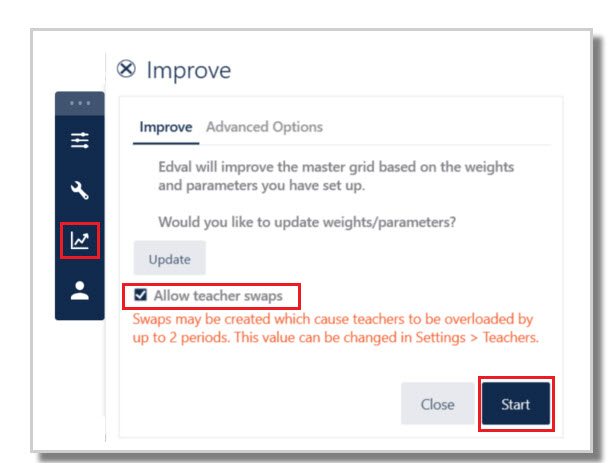
- Enable Allow teacher swaps in the Improve panel to explore more solutions.
- Manually swap staff, even if it creates a new clash (which may be easier to resolve), then run Improve.
4. Use Pin Staffing strategically
- Use pin Staffing to control which classes can change.
- Example approach:
- Pin all staffing
- Unpin relevant classes using wildcards (e.g. 8HIS*, 7HIS*)
IMPORTANT
Pinned staffing gets cleared if you leave the Master grid.  Reapply pin/unpin settings before running Improve.
5. Broaden investigation
- Don’t rely only on the Master grid. Check Year Timetables and Group Timetables.
- Look for constraints such as:
- Elective lines occupying periods
- Multiple part-time teachers in one group
- Pinned or hard-coded classes limiting movement
6. Split classes
If a clash cannot be resolved, consider split classes:
- Go to the teacher’s timetable
- Select the clashing lesson
- Press T and assign a different teacher for that lesson
Solving room clashes
As it builds the timetable the algorithm checks that each class can be given the room it requires if placed in any given period. It manages all resources (teacher and rooms) when constructing, so it is important to ensure room data and subject room options are accurate.
- Check rooms in Rooms > Room data are marked as General (G) or Specialist (S), and room capacity are correct.
- Check Rooms > Subject rooms are accurate.
- Check specialist subjects have a ‘Y’ in the ‘Only’ column to indicate that the subject must get only one of the rooms listed (rather than resort to a General room). Remove the 'Y' entry when not required to relax rooming restrictions.
- Check Class data > RoomPref field. Is there old, incorrect data here? It is usually best to leave the RoomPref cells empty, so that the full set of room options listed in Rooms > Subject rooms are considered.
Solving spread issues
As spread issues become known, and in order to attempt to fix them, consider the following:- Check Classes > Class data has the required spreads for all classes.
- Has the Improve function been run for some time? (Time varies depending on the complexity of the file.)
- Are part timer days off forcing classes to be timetabled in such a way that the classes cannot possibly get the spreads they have requested?
- Investigate in several timetabling views why the class spread cannot be achieved, e.g. Year timetables, Group timetables.
- Tweak the relevant parameter in Master grid > Action bar: Weights > Spreads. Add Exception if needed.
- Increase the penalty for Master grid > Action bar: Weights > Main > Spread tab.
- Reset the Spread weights and/or Main weights to default values in case they became unbalanced after adjustments made in previous versions.
Health Check
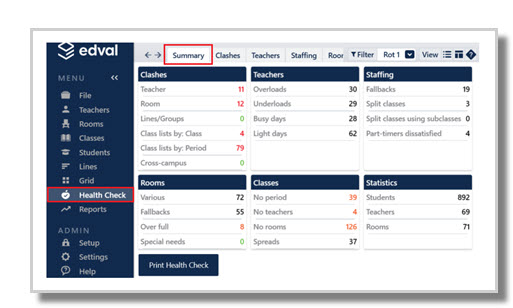
- Look at the Health Check summary screen regularly throughout the process of adding classes.
- The Summary page provides a very helpful at-a-glance listing of issues, and each issue may be clicked on to look at the details. In particular, check:
- Clashes > Teacher
- Teachers > Busy days
- Classes > Spreads. A clash-free timetable is still not acceptable if classes don’t have the spreads they need!
Was this article helpful?
That’s Great!
Thank you for your feedback
Sorry! We couldn't be helpful
Thank you for your feedback
Feedback sent
We appreciate your effort and will try to fix the article