TABLE OF CONTENTS
Preamble
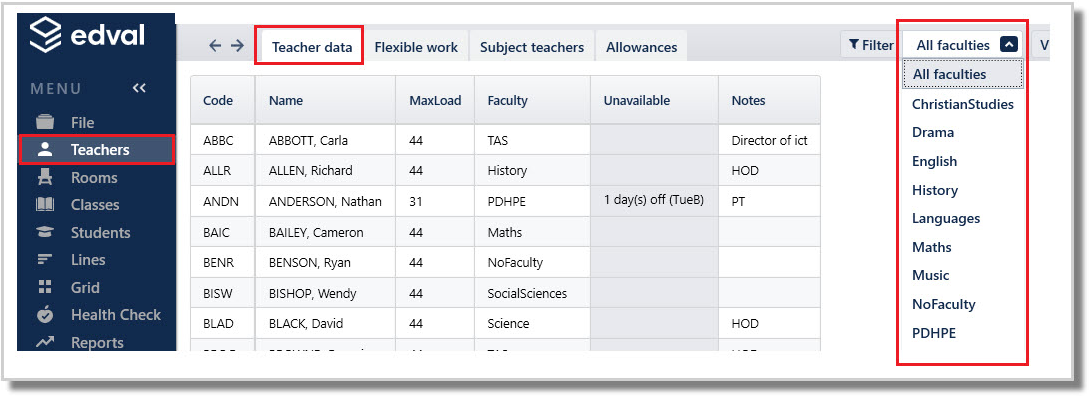
Teachers > Teacher data (F2) is a data entry table where you enter all teaching staff associated with the school. Once entered into this table, every teacher is eligible to be allocated classes for teaching in other parts of the program.
WARNING
Most schools do not add administration (office) staff to this table. Only those staff members that will be allocated to classes as teachers, support staff or the Duty roster need to be added to this table. Administration staff can be added to Tes Timetable Daily (if your school is licensed) for the purpose of keeping track of leave.

More details here: Timetable Daily: Admin - Users: User Management
View options
Faculty Filter
Teacher data can be viewed by individual faculty or across All faculties. Use the Faculty filter (top right) to choose a specific faculty or select All faculties. When All faculties is selected, an additional Faculty column is displayed.
NOTE
Teachers can only belong to one faculty for grouping purposes, but may be included in Subject teacher options for subjects in any faculty. Therefore it is important to place teachers in the faculty where they teach the majority of their subjects, so that they will appear grouped with like teachers in other screens.

To create new faculties, or edit existing faculties, go to Admin > Setup > Faculty data.

More details found here: E10 - How to: Can a teacher teach in multiple faculties?
Displaying Fields
Columns can be sorted by double-clicking on any column heading.
Default fields

1. Code
A short code used to refer to the teacher. This code should match the codes used in your school admin system, where possible. The preferred format is to use the first 2 or 3 letters of the teacher's surname, followed by the first letter of the given name. This allows sorting on codes to sort by surname.
Example: Neil Bark = BARN.
2. Name
The teacher's name, in the preferred format of "SURNAME, Given name" so that sorting will be done by surname. The surname is clearly identified in capitals and separating the first name by a comma, to ensure the name is correctly interpreted in exports.
Example: BARK, Neil
3. MaxLoad
MaxLoad is the maximum load each teacher can be allocated, including non-teaching allowances, expressed as the number of periods per cycle (to 2 decimal place.) E10 will calculate the equivalent value based on the data in the FTE column and in Setup > School info, but it can be manually adjusted afterwards if needed. Ideally, all full-time staff will have the same MaxLoad. Positions of responsibility and non-teaching loads will be entered into Teachers > Allowances. E10 will subtract all allowances from the MaxLoad to calculate the number of teaching periods a teacher can be assigned.
4. Faculty
When filtered by a single faculty, the faculty column is hidden. When selecting ' All faculties', the faculty field with be displayed.
5. Unavailable
A list of days and/or periods during which a teacher is unavailable per cycle. Unavailable entries should only be used when a teacher is off‑site and not undertaking school business. They should not be used to block periods for school activities such as assembly setup or teaching a primary class. These activities should instead be entered in Classes > Class data (F6) as a class or a meeting in the Meetings year level. Recording activities this way shows what the teacher is actually doing on their timetable and allows them to be cancelled on a day‑by‑day basis, unlike unavailable entries, which are more permanent (e.g. RDO's for part-timers).
NOTE
By default, classes created in the Meetings year level counts towards a teachers load in the 'Non-teach' category.

More details: E10 - Creating meetings
WARNING
Schools that are using Multi-grid will need to have assigned a 'Main Campus' in 'Teachers > Teacher data' to ensure the Unavailabilities appear correctly in Tes Timetable Daily.
More details on how to use Flexible work tab here: E10 - Part timers: Best practice
6. Notes
This is a free-format text field. It is not used in the timetable generation process but allows you to record general comments about the teacher.
Example: 'Long service leave Term 3'
WARNING
The Notes text displays in Tes Timetable Daily and will be visible to anyone with access to it, so be careful to enter text appropriately.
Additional fields
The View menu (top-right) allows you to display additional fields.
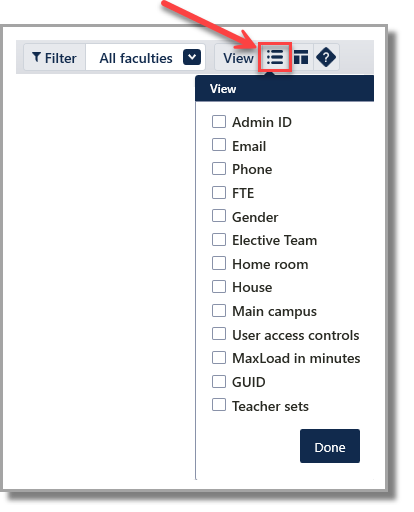
Admin ID
The code used by Student Management System's (e.g. Compass ID, Sentral ID) that E10 syncs with. If a different teacher code is used within E10, the official system code is entered here. These must match for successful integration and syncing.
Displays teachers' email addresses (email entry is needed when sending daily bulletins via Tes Timetable Daily).
Phone
Displays teachers' phone numbers.
FTE
Teachers' full-time equivalent loading. In Setup > School Info, the full-time load per cycle is entered. This is the equivalent in periods and minutes of a full-time teacher with FTE = 1.0. This does not include non-teaching Allowances or Duties. All full-time staff should be on the same FTE.
NOTE
FTE is important for Daily Organisers to calculate part-time cover loads in Tes Timetable Daily.
Gender
Displays the teacher's gender. Valid entries are F, M or X.
Elective team
An obscure feature used by US schools with the 'Tertiary Features' of elective line construction.
Home room
Enter the room code of the room where the teacher mostly teaches, if your school is lucky enough to have enough rooms to allow this. That teacher will then almost always have their classes allocated to this room, provided the room is also in the room set for that class. This column is the same column as 'Homeroom Of' in Rooms > Room data (F5).
More details here: E10 - How To: Set up Home Rooms for Teachers or Students
House
Assign teachers to a house as defined in Students > Sporting house data. It may be useful for exports. Some schools create classes for House, which can be more flexible.
Main campus (only for files with multi-campuses)
Assign each teacher to a campus where they most likely teach. Affects which grid is used for their timetables, and in interpreting the 'unavailable' syntax and allocating duties.
User access controls
Restrict the access rights of individual staff to view and make changes to data. To create access or change access, press 'Edit ' and add a password.
MaxLoad in minutes
Displays teacher loads counted by the minute (format hours : minutes). E10 will calculate the equivalent value based on the data in the FTE column and in Setup > School info, but it can be manually adjusted afterwards if needed.
GUID
This is a globally unique identifier for an object such as a code, class, room, teacher or student. This field cannot be edited. It is used when synchronising between different software systems.
Teacher sets
This screen shows an overview of all the courses that each teacher is considered as an option to teach, either as a preferred, (fallback) or (if desperate) option. It is not a listing of what they are currently teaching, nor necessarily what they will be assigned to teach; it is the courses that E10 will consider them to teach. This view is a summary subject list per teacher, in comparison to Teachers > Subject Teachers, which shows a list of teachers per subject.
Editing Teacher data
Edit teacher code
WARNING
When you change a teacher’s code, a pop up will prompt you to confirm whether the teacher is the same person or a new person. Making the correct selection is important, as it directly affects teacher history, particularly if you use Daily. Select Same person if the same teacher is keeping their existing record and simply requires a new code. Select New if a different teacher is replacing the previous one.
Add a teacher
Enter the new teacher’s details into the bottom blank cells or press Insert on your keyboard. If new teachers are to be hired but the name is not yet known, ‘NEWMAT,’ as an example, can be entered for a new Mathematics teacher. The details can be changed once known.
WARNING
A teacher’s name must not contain the words “teach,” “teacher,” or “study.” These are reserved keywords within E10, and using them will cause the system to crash. This is a common mistake when adding a dummy or placeholder teacher.
Delete a teacher
Click in the teacher's Code cell and hit delete on the keyboard. All teaching allocations must be removed from the teacher before being permitted to delete the teacher.
Add/edit the Faculty
Choose All faculties on the filter, then enter the correct faculty into the Faculty cell. E10 will auto-complete the faculty once recognised.
Edit FTE/Unavailability
When you change a teacher’s FTE, it is essential to update the Unavailable column - and vice versa.
For example, if a teacher moves to 0.8 FTE, make sure their allocated day off is added in the Flexible Work tab. If a teacher returns to full time, delete any previously assigned days off. Also, check that the Maxload column is correct. Maintaining accurate FTE, Maxload and unavailabilities is critical for generating a correct timetable.
More details on how to use Flexible work tab here: E10 - Part timers: Best practice
Was this article helpful?
That’s Great!
Thank you for your feedback
Sorry! We couldn't be helpful
Thank you for your feedback
Feedback sent
We appreciate your effort and will try to fix the article