TABLE OF CONTENTS
- Preamble
- Headings explained
- Active / Inactive students
- Unassigning students from classes
- Warning colours
Preamble
View options

Headings explained
Heading | Details |
*Code | Unique alphanumeric identifier which should match the school's admin system to enable sync matching. If a duplicate code is entered, E10 will display a warning and will highlight the code with a red box. If a code is not present E10 will automatically generate one.  |
Name | Student's name: <SURNAME, First name> order is preferred. eg SMITH, Jane |
*Year | Year level of the student. |
StatewideID | This is the official state-wide code used by the relevant Education authority to identify the student and used by the school’s Student Management System. It may be different to the shorter internal student code. |
M/F | Gender. M = Male, F = Female, X = Unspecified Used to identify students by colour in class lists management screens. M = blue, F = pink, X = white.  |
Indigeneity | Enter A if the student identifies as indigenous. |
Boarder | Enter Y to categorise students as boarders. Used for Interviews |
Letter | Enter the letter group of the student. Letters A-Z may be used. Note that E10 will insert the year level of the student; the user does not need to enter the year level. Used for exports, sorting or class list management purposes. |
Number | Enter the number group of the student. Single-digit numbers (only) 0 - 9 may be used, along with some additional honorary characters $ & < > { } ~ % * ` ~ Note that E10 will insert the year level of the student; the user does not need to enter the year level. Used for exports, sorting or class list management purposes. |
House | If Houses have been set up in the Students > Sporting house data |
Email | Email address. Used for Choice. |
Phone | |
Comment | Free text. Displays in class lists. |
GUID | A unique identifier generated by an external system. This field is not usually referenced by the user. |
WebCode | WebCodes will be populated if the student has been included in a Choice form. |
Funding | Allowable values: A-Z and 1-9 |
Class | All classes the student is enrolled in will display, one class per column. It is possible to enter or delete class codes from these cells, but be aware that there is no clash management occurring. Best class list management practice methods: A) Students > Class list manager (By class, letter, or auto-populate) B) Students > My Classes |
Active | This column will display the status of each student as 'Active' or 'Inactive' and can be sorted so that inactive students appear at the bottom of the table. |
Active / Inactive students
Active: Make an inactive student active again. (If the student is already active, then their status will not change.)
Delete: deletes the student completely from the file.


Unassigning students from classes
Students can be removed from classes via the Students > Student data screen by clicking on the class code along the relevant student's row and deleting the entry.
Please note that this method only works for classes that are not tied to the Group class lists function.
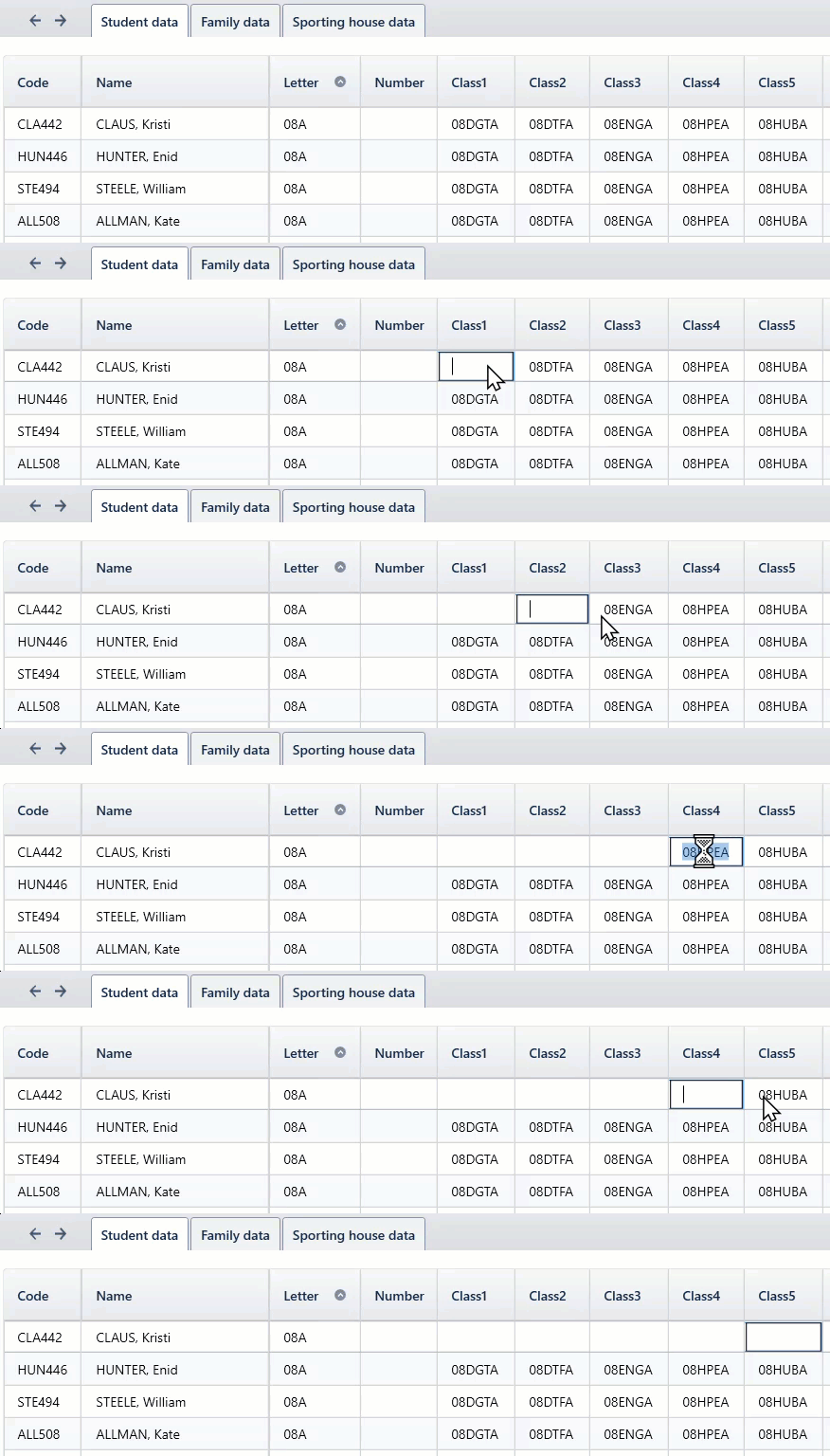
If you need to unassign a student from classes that are linked to the Group class lists function, first remove them from their previous Letter and/or Number group assignment so they are completely unassigned from the classes using this function. This also applies for scenarios where a student needs to move to another year level within the timetable. They will need to be removed from their previous Letter and/or Number group, then moved to the appropriate year level using the Year column, and then re-assigned to their new Letter and/or Number group. This is the most reliable way to update their data within the timetable file.
Each year level has its own unique Letter and Number groupings that do not interact with other year levels in the file. If a student is tied to a Letter and/or Number group through the Group class lists function, and is moved to a new year level without first being removed from their previous group, they can remain linked to that original year level's letter group. This can result in warning messages indicating that the group does not exist or that the student is still assigned to another group in a different year level.
Warning colours

Was this article helpful?
That’s Great!
Thank you for your feedback
Sorry! We couldn't be helpful
Thank you for your feedback
Feedback sent
We appreciate your effort and will try to fix the article